
For restaurants, payment processing fees are a major cost. The rates advertised by Stripe or Toast shouldn’t be taken at face value—the real cost depends on your average ticket size and the mix of in-person vs. online transactions. This article is based on the standard rates offered by each provider at the time of writing. Don’t be swayed by introductory reduced-rate offers from credit card processors—these rates are often variable and can be changed with as little as 30 days’ notice. Unless your business processes well over $100k per month—enough to negotiate lower rates or qualify for custom pricing—these initial deals may not reflect your long-term processing costs. Also review your statements for hidden fees—like “non-qualified” or “downgraded” transactions—which can add 1%+ per transaction above the advertised rate. Some providers sell through resellers/ISOs (e.g., Clover sold via partners), adding another layer of markup and additional contractual obligations.
The following comparison strictly focuses on payment processing fees only and does not cover the restaurant software features offered by each provider. While Toast delivers an all-in-one restaurant software suite, Stripe does not include restaurant-specific tools. That’s where our PieConnect platform fills the gap by combining Stripe’s transparent low-cost payment processing with a fully integrated restaurant management solution.
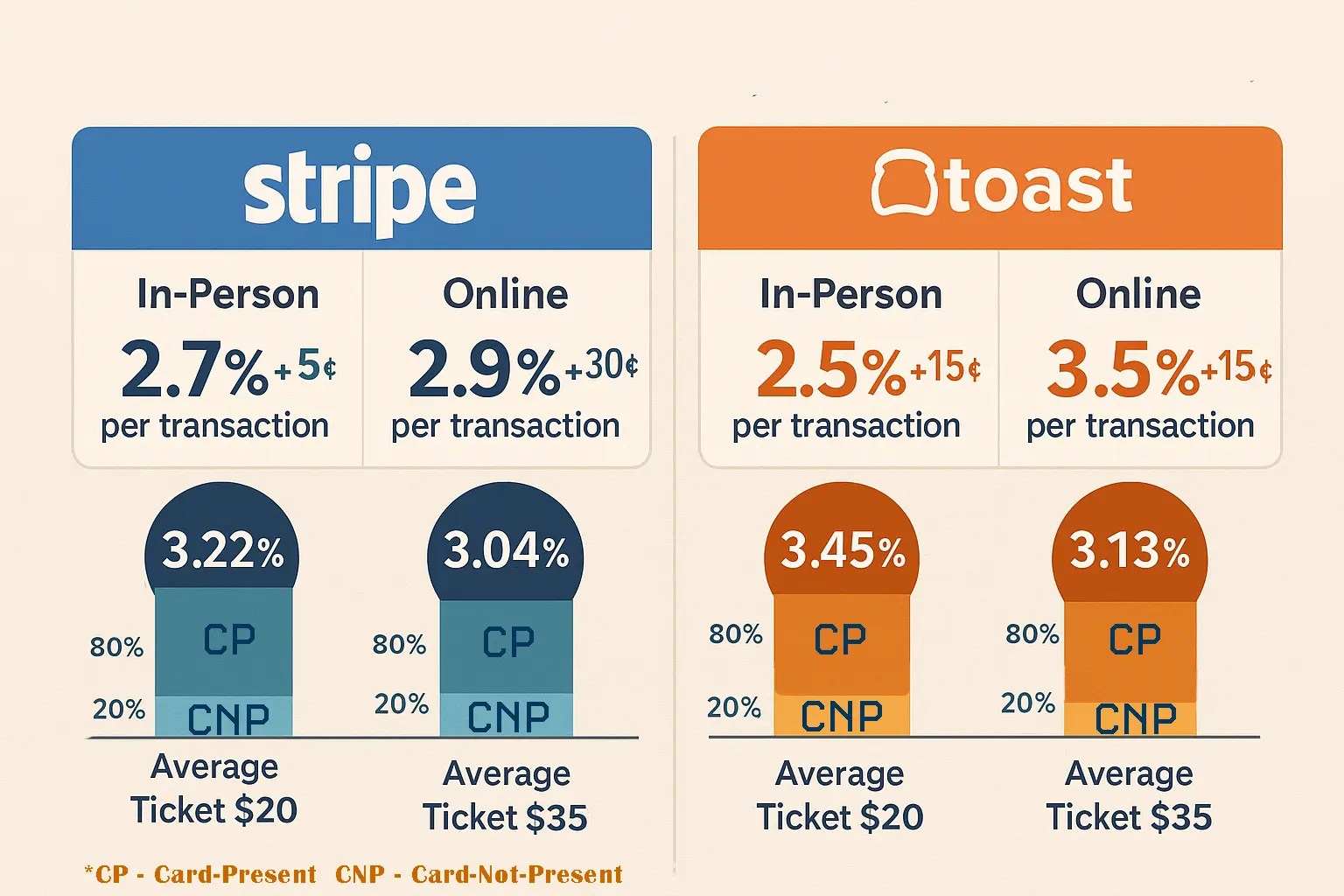
Processing Fee
| Provider | Transaction Type | Fee Structure |
|---|---|---|
| Stripe | In-person (card-present) | 2.7% + $0.05 per transaction |
| Online (card-not-present) | 2.9% + $0.30 per transaction | |
| Toast1 | In-person (card-present) | 2.5% + $0.15 per transaction |
| Online (card-not-present) | 3.5% + $0.15 per transaction |

Graph 1: Effective Fee % by Ticket Size
Shows Stripe vs Toast based on pure in-person vs online transactions across $5 to $100.
Based on the graph above, Stripe (Card-Present aka In-Person) is generally cheaper than Toast (In-Person) across most average ticket prices, especially under $50. Conversely, Toast (Card-Not-Present aka Online) offers lower fees than Stripe (Online) for smaller ticket sizes (below $25), but Stripe becomes more cost-effective for online payments at higher amounts. Still, the effective fee alone doesn’t tell the whole story—the mix of in-person and online transactions also plays a critical role. Let T represent the average ticket size. We’ll analyze each provider assuming an 80% in-person / 20% online mix. Your online share may be higher if you have a strong digital presence, e.g., with PieConnect’s tools.
Weighted Effective Fee = (Online Rate × 20%) + (In-Person Rate × 80%)
Where each rate is calculated as: Rate = ((percentage × T) + flat_fee) / T
Example Comparison at $20 Ticket Size
| Provider | Online Fee | In-Person Fee | Weighted Avg (80% In-Person / 20% Online mix) |
|---|---|---|---|
| Stripe | 4.4% | 2.95% | 3.22% |
| Toast | 4.25% | 3.25% | 3.45% |
Example Comparison at $35 Ticket Size
| Provider | Online Fee | In-Person Fee | Weighted Avg (80% In-Person / 20% Online mix) |
|---|---|---|---|
| Stripe | 3.76% | 2.84% | 3.04% |
| Toast | 3.93% | 2.93% | 3.13% |
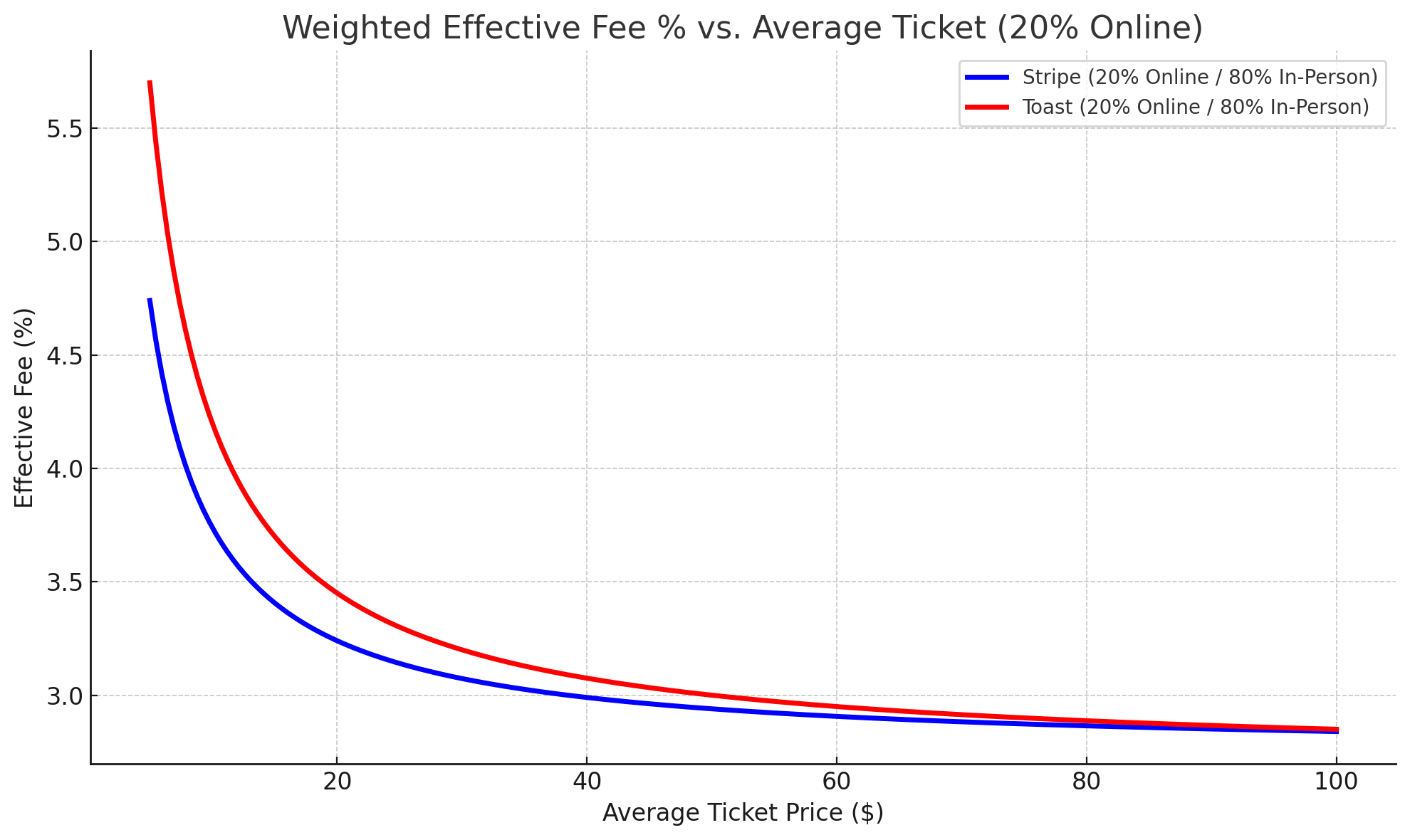
Graph 2: Weighted Fee % with 20% Online Transactions
Illustrates how even a modest share of online transactions impacts overall cost.
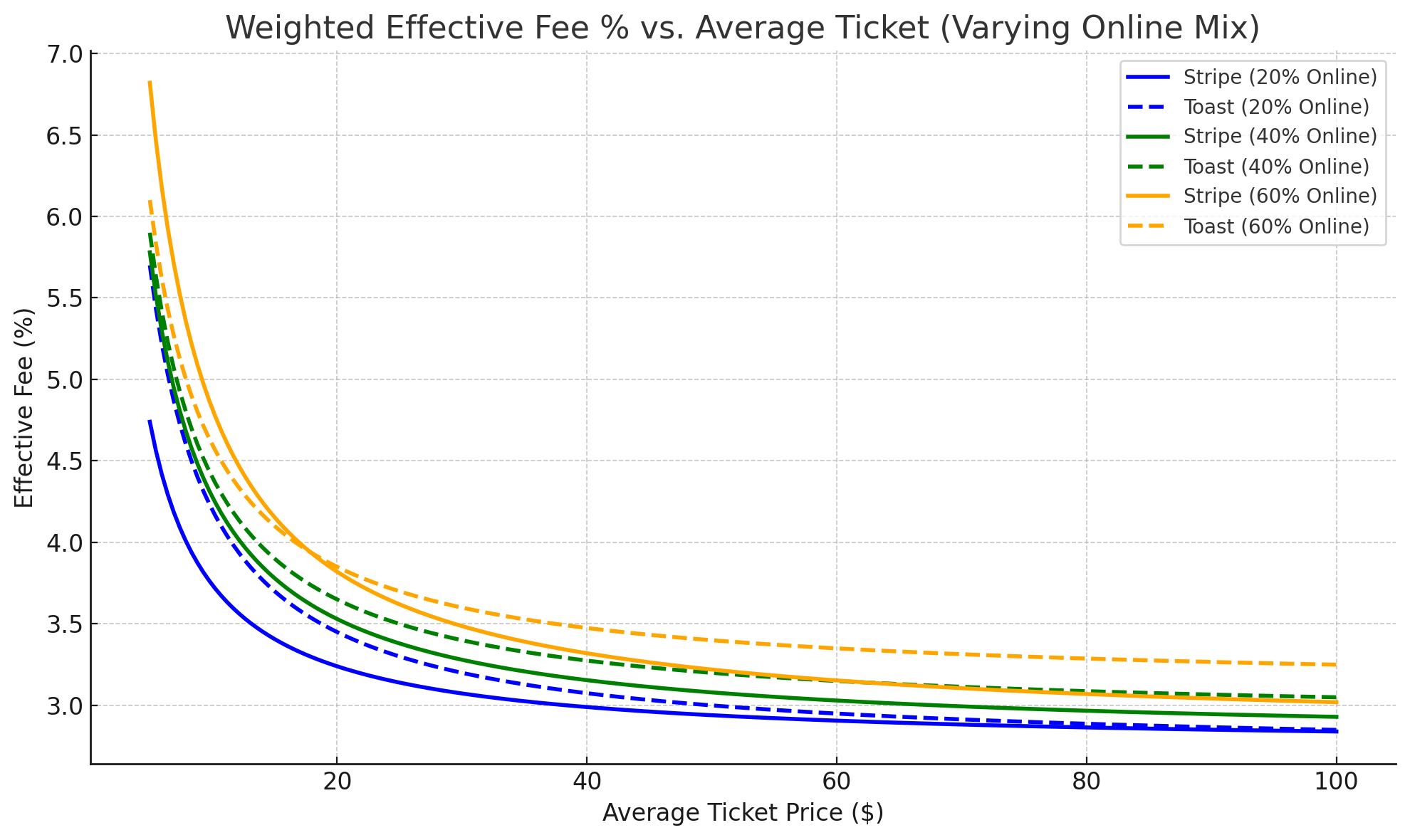
Graph 3: Varying Online Transaction Mixes (20%, 40%, 60%)
Demonstrates how the crossover point shifts as online volume grows.
Key Takeaways
- For low to mid ticket sizes ($5–$35), Stripe is generally more cost-effective than Toast, particularly with any significant online transaction volume.
- As online transactions increase, Toast’s higher online processing rate (3.5%) significantly elevates the weighted average cost.
- Stripe’s cost-effectiveness becomes even more pronounced as the online transaction mix grows.
- Only with high ticket sizes ($50+), common with fine-dine restaurants, and predominantly in-person sales might Toast become competitive or even less expensive.
Stripe can be more cost-effective because it operates as both a payment facilitator (payfac) and a direct processor2. That integrated role—combined with its scale and flexible pricing—reduces intermediaries and supports more competitive rates. Toast acts as a payfac3 (partner with Worldpay LLC) and typically bundles higher processing fees with its software and hardware, effectively adding a middle layer. Both offer volume pricing, but you’ll often have more leverage with Stripe.
- Toast’s rates can be even higher if hardware is not purchased upfront. ↩︎
- https://www.icba.org/newsroom/news-and-articles/2025/07/08/georgia-approves-stripe-application-to-form-malpb?utm_source=chatgpt.com ↩︎
- https://pos.toasttab.com/merchant-service-agreement-for-merchants?srsltid=AfmBOopBjbkb-NVOwcqTvRAhN2CxlurvTbYdXqtuv_8BBoFnROenKf2m&utm_source=chatgpt.com ↩︎
YOU MAY ALSO LIKE:
 Haalat
One response to “Why Restaurants Often Pay Less in Credit Card Processing Fees with Stripe Than Toast”
[…] Why Restaurants Often Pay Less in Credit Card Processing Fees with Stripe Than Toast […]
LikeLike